NEWS & EVENTS
Information – Events – Activities
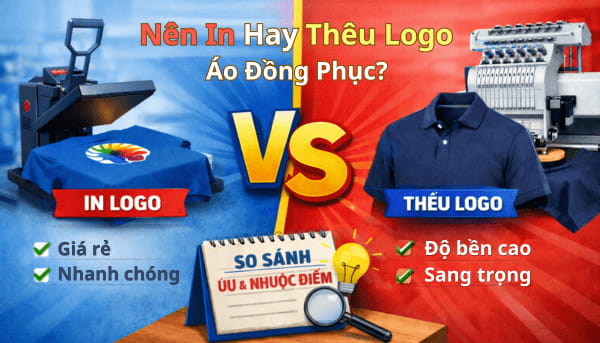
Should You Print or Embroider Your Logo on Uniforms? The Best Choice Guide
Should you print or embroider your logo on uniforms? This is a question most businesses, companies, schools, or organizations ask when ordering uniforms. Choosing the right technique not only affects cost and durability but also determines the aesthetics and professional image of the brand. In this article, we will analyze the advantages and disadvantages of both printing and embroidery methods for uniform logos, and offer specific advice to help you make the most suitable decision.
What is printing logos on uniforms? Key advantages and disadvantages
Printing logos on uniforms is a technique that uses specialized inks (screen printing, digital printing, heat transfer printing, DTG printing, etc.) to transfer images, logos, or patterns directly onto the fabric surface. This is the most common method today, accounting for a high percentage of uniform orders.
Advantages of printing logos on uniforms:
- Cost-effective: Printing is usually cheaper than embroidery, especially for large quantities or complex logos. - Costs are calculated based on the number of ink colors and size, without significant increases for larger images.
- Fast turnaround time: Hundreds of shirts can be printed in just a few hours to a day, ideal for urgent orders.
- Unlimited colors and details: Prints multi-color logos, gradients, complex images, and small, fine text with sharp detail. This is a major advantage over embroidery.
- Smooth, flat shirt surface: No bulkiness, wrinkles, or bumps, ensuring comfort, especially with stretchy fabrics.
- Suitable for various locations: Can be printed on the chest, back, sleeves, or entire body without making the shirt heavy.
Disadvantages of printing logos on uniform shirts:
- Limited durability: After multiple washes (especially machine washing or using hot water), the ink is prone to fading, peeling, or cracking if low-quality printing technology is used.
- Dependent on fabric material: Prints best on light-colored fabrics (white, light colors). On dark or very thin fabrics, the logo is easily smudged and lacks sharpness.
- Easily affected by weather and friction: Printed logos can fade with prolonged exposure to sunlight or strong friction.
In short, logo printing is very suitable for event uniforms, team uniforms, sales staff uniforms, or when budget is limited and a quick completion is needed.
What is embroidered logo on uniforms? Detailed advantages and disadvantages
Embroidery of logos on uniforms (computerized embroidery) uses a specialized embroidery machine controlled by software, placing embroidery thread onto the fabric stitch by stitch to create the logo. This technique provides a high-end, handcrafted feel.
Advantages of embroidered logos on uniforms:
- Superior durability: Embroidered logos are durable, do not peel, fade, or deform even after multiple washes, hot ironing, or long-term use. This is an ideal choice for everyday uniforms.
- High-end aesthetics: Embroidered logos stand out, creating a more professional, luxurious, and sophisticated feel. Many businesses choose embroidery to showcase their brand's prestige.
- Suitable for many fabrics: Embroidery works well on most fabrics, including thick or less stretchy fabrics, and can be ironed directly without fear of damage.
- Maintains shape well: The logo does not crack or break when the garment is slightly stretched.
Disadvantages of embroidered logos on uniforms:
- Higher cost: Embroidery is priced per stitch, so large logos or complex details will significantly increase the cost. It is usually 20-50% more expensive than printing, depending on the size.
- Limited color and detail: Standard embroidery machines can only use 6-12 thread colors, making it difficult to represent gradients or multi-colored logos. Overly complex images or thin text are prone to losing detail.
- Longer production time: Requires programming the embroidery file, and the machine runs slower than printing, making it unsuitable for urgent orders.
- Size limitations: Overly large embroidered logos can be bulky, wrinkle the fabric, and make the shirt uncomfortable, especially with thin jersey fabric. It's generally best to embroider a small logo on the left chest or back of the neck.
Embroidery is most suitable for office uniforms, banks, hotels, schools, or organizations that want to build a long-lasting, professional image.
Comparison of Printed and Embroidered Logos on Uniforms:
Below is a visual comparison table for your easy understanding:
- Cost: Printing is cheaper – Embroidery is more expensive (especially for large designs).
- Durability: Printing is average (fades easily after 1-2 years) – Embroidery is high-quality (lasts 3-5 years or more).
- Aesthetics: Printing is sharp but flat – Embroidery is more prominent and luxurious.
- Color & Details: Printing offers a wide variety of colors, unlimited – Embroidery has limited colors, suitable for simple logos.
- Time: Printing is faster – Embroidery is slower.
- Fabric suitability: Printing works well on thin, stretchy fabrics – Embroidery works well on thick, less stretchy fabrics.
- Size: Printing is easy to make large – Embroidery should be kept small to a suitable size.
Depending on your budget, frequency of use, and image goals, choose the appropriate method. Many companies combine both: printing on the back (large slogan) and embroidering a small chest logo to balance cost, aesthetics, and durability.
Should you print or embroider your uniform logo? Practical advice
- Choose printing if: Budget is limited, the logo is complex with many colors, a large quantity is needed and completion is required quickly, uniforms are for short-term use or events.
- Choose embroidery if: You want high durability, a professional and elegant image, uniforms are for long-term use, and the logo is simple and small.
- Combining printing and embroidery: This is the optimal solution for many businesses today, being both cost-effective and creating a distinctive look.
Additionally, pay attention to the fabric material (cotton, cool-touch fabric, khaki...), shirt color, and logo placement when making your decision. Choose a reputable manufacturer for free consultation and sample testing before placing a large order.
If you are unsure whether to print or embroider your company's uniform logo, contact our experts for design consultation and a detailed quote that best suits your needs.
Contact Information:
Tien Thanh Production, Trading and Investment Co., Ltd.
ORDERPRINTINGANDEMBROIDERY - DIRECTPRINTINGANDEMBROIDERYWORKSHOP

CONTACTUSNOW
GETDESIGNSAMPLES
ORDERPRINTINGANDEMBROIDERY - DIRECTPRINTINGANDEMBROIDERYWORKSHOP

CONTACTUSNOW
GETDESIGNSAMPLES
PROFESSIONAL CONSULTING AND PRODUCTION