NEWS & EVENTS
Information – Events – Activities
What is PET printing? Reliable PET printing services in Nam Dinh
In today's printing and garment industry, PET printing (or heat transfer PET printing) is becoming one of the most popular technologies due to its ability to print sharp images, vibrant colors, and its flexible application on many materials. If you are wondering "What is PET printing?" and "Is PET printing durable?", this article will answer all your questions in detail and in the easiest way possible.
1. What is PET printing?
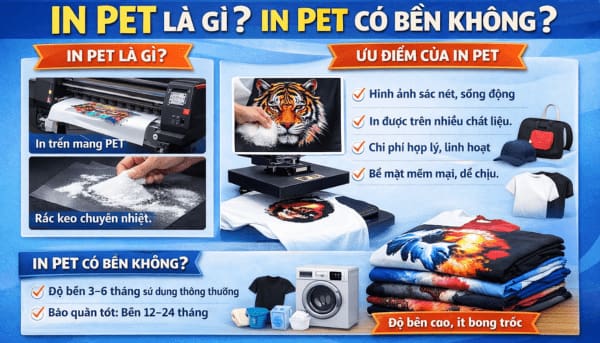
PET printing is a heat transfer printing method that uses PET (Polyethylene Terephthalate) film as an intermediate material to transfer images and patterns from the printing film to the surface of the final product.
PET film is produced from Polyethylene Terephthalate resin – a type of polyester resin with high durability, transparency, flexibility, and good heat resistance. The heat transfer PET printing process includes the following main steps:
- Printing the image onto the PET film using a specialized printer and high-quality ink.
- Applying a heat transfer adhesive (powder) layer to the printed surface.
- Cut out the image according to the design and place it onto the material to be printed (T-shirt, fabric bag, uniform, etc.).
- Use a heat press at a temperature of approximately 160–200°C for a certain amount of time to melt the adhesive and firmly bond the image to the material surface.
Thanks to the heat transfer mechanism, the image is not printed directly onto the fabric but "transfers" through the adhesive layer, allowing the colors to penetrate deeply and maintain high realism. This technology emerged and became widely popular around 2020, quickly replacing some traditional printing methods due to its flexibility.
PET printing differs from regular heat transfer decal printing in that it uses PET film as an intermediate layer instead of decal paper, resulting in a softer, less stiff, and glossier printed image compared to decal.
2. Outstanding Advantages of PET Printing Technology
PET printing offers many superior advantages compared to other printing methods such as screen printing, decal printing, or direct printing:
- Vivid, high-definition colors: Images reproduce details well, with accurate colors even on dark (black, navy…) and light-colored fabrics. No smudging, blurring, or discoloration.
- Applicable to many materials: Can be printed on most types of fabrics (cotton, polyester, jersey, windproof fabric, khaki…) and some other surfaces such as wood, plastic, metal, and glass.
- No quantity limitations: Suitable for printing individual items (1–10 pieces) as well as large quantities. Wide printing size (usually 58–60cm x 1m) helps increase productivity.
- Reasonable cost: Usually 1/3 to 1/5 cheaper than traditional heat transfer decal printing, especially when printing in large quantities.
- Soft surface: The printed image is flexible and breathable, not stiffening the fabric or causing discomfort when worn, unlike decals which easily create a "plastic-like" feel.
- Free design: Complex patterns, gradients, and photographs can be printed without being limited by the number of colors like screen printing.
Thanks to these advantages, PET printing is very popular in the production of uniform t-shirts, group shirts, event shirts, canvas bags, backpacks, baseball caps, and many other promotional and gift products.
3. Is PET printing durable? What is the actual durability?
This is the question most frequently asked by customers. The answer is: PET printing has good durability, but the level of durability depends on several factors:
- Quality of PET film and ink: High-quality PET film + specialized ink for heat transfer will provide higher adhesion and colorfastness.
- Heat pressing technique: The correct temperature, time, and pressure of the pressing process help the adhesive penetrate deeply, reducing the risk of peeling.
- Usage and Care Instructions: Machine wash on a gentle cycle, water temperature below 40°C, avoid strong detergents, turn the garment inside out when washing, and dry in the shade to help the print last longer.
Actual Durability:
- PET prints typically last 3–6 months with daily use if properly cared for.
- With careful handling (hand wash or machine wash on a gentle cycle, avoid ironing directly on the print), the lifespan can extend to 12–24 months or more without fading, peeling, or cracking.
- Compared to decal printing: PET prints are generally softer and more breathable, but colorfastness may be slightly inferior to decals in some cases of vigorous washing. However, many real-world reviews show that PET prints are more scratch and abrasion resistant thanks to the heat transfer adhesive layer.
In short, PET prints are durable if you choose a reputable printing company and use them correctly. Not as "permanent" as industrial screen printing, but perfectly suitable for general use in uniforms and fashion t-shirts.
4. Disadvantages to Note When Using PET Printing
Despite its many advantages, PET printing still has some limitations:
- Durability may decrease if washed too many times in a high-powered washing machine or with strong detergents/bleach.
- The printed image is easily stained (fabric color seeps into the image) if washed with dark-colored clothes and not turned inside out.
- Not suitable for products subjected to extremely strong friction or frequent contact with strong chemicals.
- Requires a heat press machine and experienced technicians to avoid uneven pressing, blurry prints, or premature peeling.
5. Quick Comparison of PET Printing with Other Technologies
- PET Printing vs. Heat Transfer Decal Printing: PET printing is softer, more breathable, and cheaper for large quantities; decal printing has sharper edges but is stiffer and more expensive.
- PET Printing vs. Screen Printing: Screen printing offers excellent colorfastness for large quantities but has limited color options and is difficult to print complex images; PET printing is more flexible with diverse designs.
- PET Printing vs. Direct-to-Garment (DTG) Printing: Direct-to-garment printing penetrates the fabric more naturally but is more expensive and difficult to print on dark backgrounds; PET printing is easier to print on dark backgrounds and is more durable in some cases.
6. Practical Applications of PET Printing
This technology is widely used in:
- Clothing: T-shirts, polo shirts, hoodies, company uniforms, group/class shirts, sportswear.
- Promotional gifts: Fabric bags, backpacks, hats, pennants.
- Packaging and labels: PET labels, PET decals for bottles, consumer products.
- Decoration: Printing images onto wood, plastic, and metal for small signs and souvenirs.
With the development of large-format PET printers and high-quality PET film, this technology is increasingly becoming the optimal choice for both small garment factories and large businesses.
Conclusion: When should you choose PET printing?
If you need to print t-shirts, uniforms, or fabric products with requirements for beautiful colors, reasonable cost, flexible quantities, and moderate to good durability, then heat transfer PET printing is a very worthwhile solution. This is not only a modern technology but also brings high aesthetic value to the product.
To achieve optimal durability, choose a printing company with modern machinery, genuine PET film and ink, and follow the manufacturer's care instructions.
Contact Information:
Tien Thanh Production, Trading and Investment Co., Ltd.
Contact us today for a free consultation on high-quality, competitively priced PET printing services and receive a detailed quote tailored to your needs.
GETDESIGNSAMPLES

ORDERPRINTINGANDEMBROIDERY - DIRECTPRINTINGANDEMBROIDERYWORKSHOP
GETAQUOTE
GETDESIGNSAMPLES

ORDERPRINTINGANDEMBROIDERY - DIRECTPRINTINGANDEMBROIDERYWORKSHOP
GETAQUOTE
CONTACTUSNOW